


Trade show exhibits are a staple of experiential marketing because they offer brands a unique opportunity to engage with their audience face-to-face. To truly stand out, exhibitors must embrace new trends, technologies, and strategies that push the boundaries of what's possible. Through case studies and best practices, we provide a practical roadmap for brands looking to elevate their trade show presence and achieve their experiential marketing goals.
Play
One of the most exciting trends in experience design for trade show exhibits is the incorporation of play. Far from frivolous, play is a powerful tool for enhancing engagement, learning, and well-being. According to the National Institute for Play, playful activities relieve stress, improve brain function, boost creativity, and foster social connections. For brands exhibiting at trade shows, incorporating elements of play into their experiences attracts attendees, prolongs dwell time, and nurtures meaningful, memorable interactions.
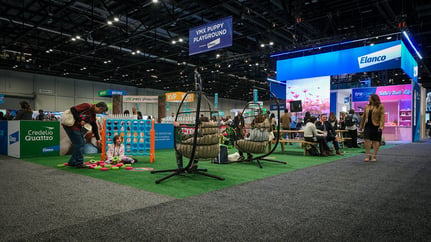 Elanco exemplified this approach at the 2025 Veterinary Conference and Expo (VMX) with a Puppy Playground that allowed attendees to take a break and play with puppies while staying immersed in the Elanco brand.
Playful experiences resonate because they tap into deep human needs and tendencies. Conveniently for brands, play can manifest in many forms, from telling jokes to solving puzzles and exploring imaginative scenarios. The key is understanding your audience and brand, then devising play-based activations to spark meaningful engagement. When executed well, play proves it belongs in even the most professional of contexts.
Recharge and Relax
While many brands compete for attention with flashy, high-energy activations, those that provide a calm, relaxing respite stand out by meeting a crucial need. Research shows that relaxing and recharging improve cognition, creativity, and memory. In a relaxed state, the brain is better able to absorb and retain information—a key goal for exhibitors looking to make a lasting impact.
.jpeg?width=508&height=286&name=ElancoVWX2025_Zen-1263%20(1).jpeg) At VMX 2025, Elanco created a bold embodiment of this trend with their immersive Zen Garden experience. Designed to introduce their "Reach for Zen" campaign for Elanco's new product, the activation transported attendees into a serene oasis of tranquility and mindfulness. The space included a peaceful sandpit, meditation gazebo offering yoga classes, hydration station, and artistic nature-inspired decor. A floral crown activity provided a creative, hands-on element to complement the overarching theme of relaxation.
At VMX 2025, Elanco created a bold embodiment of this trend with their immersive Zen Garden experience. Designed to introduce their "Reach for Zen" campaign for Elanco's new product, the activation transported attendees into a serene oasis of tranquility and mindfulness. The space included a peaceful sandpit, meditation gazebo offering yoga classes, hydration station, and artistic nature-inspired decor. A floral crown activity provided a creative, hands-on element to complement the overarching theme of relaxation.
The results speak to the power of this approach. Elanco's Zen Garden achieved an impressive average dwell time of 12 minutes, with 5,300 visitors either participating or passing through. Notably, 81% of Zen Garden visitors also explored Elanco's main exhibit, demonstrating how a rejuvenating activation drives further engagement with the brand.
ADT Commercial took a subtler but equally effective approach at GSX 2019. Their exhibit design drew inspiration from a spacious, comfortable New York loft, utilizing exposed brick, pendant lights, and a perimeter structure that balanced openness and privacy. Attendees could relax in the lounge area while learning about ADT's security solutions in a conversational setting. The inviting, unhurried atmosphere allowed the brand to build meaningful connections.
Smart Modularity
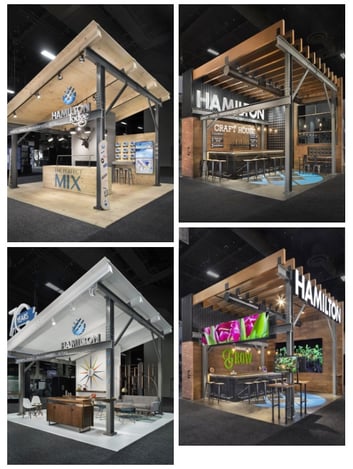 The principle of smart modularity involves designing exhibit elements as interchangeable, scalable components that can be rearranged and repurposed for different events, spaces, and objectives. Smart modularity is essential because it allows brands to create dynamic, reconfigurable environments that evolve with their needs over time.
Jack Henry exemplified the power of smart modularity in their custom trade show exhibit at the Jack Henry Annual Conference. Designed to serve sixteen shows across seven configurations, the exhibit featured a circular layout divided into quadrants. The modular approach allowed the exhibit to be deconstructed into smaller, equally impactful spaces, ensuring a unified brand experience across various events. Distinctive fabric arcs and interior lifestyle vignettes provided a consistent, recognizable presence across configurations.
Hamilton's exhibits at EXHIBITORLIVE from 2016 to 2019 demonstrated the creative potential of modular design. Using the same physical structure as a base, Hamilton transformed the space into a ski lodge, mid-century modern living room, craft beer house, and garden cottage over the four-year run. By reimagining the environment each year within a consistent architectural framework, Hamilton created fresh, immersive experiences that showcased the flexibility and longevity of modular exhibits
Grand River Aseptic Manufacturing's exhibit offers another compelling example of smart modularity in action. Hamilton designed a modern, scalable exhibit that accommodates Grand River's evolving business needs and could adapt to 20' x 20', 15' x 20', or 10' x 20' spaces. The exhibit's modular elements and unique design features allowed it to make a strong impact in any configuration, setting the stage for building client relationships and achieving trade show success.
Innovation
.jpg?width=483&height=272&name=Dematic_Modex_8%20(1).jpg) Innovation in experience design takes many forms. The common thread is a commitment to pushing boundaries, challenging conventions, and creating experiences that are fresh, surprising, and deeply engaging.
Innovation in experience design takes many forms. The common thread is a commitment to pushing boundaries, challenging conventions, and creating experiences that are fresh, surprising, and deeply engaging.
Dematic celebrated the spirit of innovation at MODEX 2024 with an exhibit that reimagined the possibilities of a digital presence. The result was a sleek, all-black exhibit featuring 550 synchronized LED video components, including extensive video walls, bars, and an anamorphic screen displaying 3D animations of Dematic's equipment solutions. Interactive elements, such as a VR experience navigated by wireless controllers, engaged attendees in a hands-on exploration of Dematic's solutions. The exhibit's success in attracting and engaging visitors underscored the power of innovation to create memorable, impactful experiences.
Wabash National took a different but equally innovative approach at the North American Commercial Vehicle (NACV) Show. To educate attendees about their future-forward product solutions and "First to Final Mile" marketing campaign, Wabash partnered with Hamilton to create a 110' x 70' exhibit featuring a range of cutting-edge elements. A centrally located "Solutions Lab" served as the heart of the innovation, demonstrating new technologies through interactive tactile and digital displays. Using RFID "lift and learn" technology, attendees could pick up product samples to trigger detailed information on adjacent touch screens—a hands-on, self-guided experience that brought Wabash's innovations to life in an unforgettable way.
Sustainability
Sustainability is a critical focus for the trade show industry, reflecting a broader societal value of environmentally responsible practices. The trend is driving innovation in exhibit design, materials, and processes, as well as a renewed emphasis on reducing waste and promoting circularity. Notably, a recent McKinsey and NielsenIQ study found that products making sustainability claims achieved 28% higher cumulative sales growth over the past five years compared to products not making such claims.
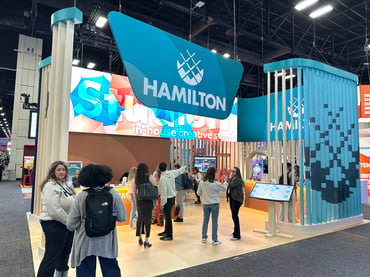 Hamilton exemplified ecoconsciousness at EXHIBITORLIVE 2025 with a multifaceted commitment to sustainability woven throughout the exhibit. The design prioritized recycled and repurposed materials. Hamilton ensured that all of the flooring and padding were recycled post-show. Aluminum extrusion panels used for the closet and counters were sourced from Hamilton's rental inventory, while custom countertops and fabric were allocated for internal use. Even the TimberStrand® framing used for the exhibit's exterior was selected for its sustainability profile and was repurposed into shipping crates after the show. A focus on local sourcing and small business support complemented these carefully considered material choices. By partnering with local vendors for the in-booth activation, Hamilton reduced transportation-related environmental impact while supporting the host city's economy.
Partner with Hamilton
As these trends and examples demonstrate, the future of experiential marketing in trade show exhibits holds exciting possibilities. Bringing these cutting-edge ideas to life requires a partner with the expertise, experience, and capabilities to execute flawlessly.
That's where Hamilton comes in.
Hamilton is a full-service experiential and event marketing agency with a 75-year legacy creating immersive brand experiences for companies throughout North America and around the world. We design, produce, and execute integrated experiences – exhibits, events, environments, and digital solutions – that drive meaningful connections between your brand and your audience.
To take the next leaps forward, contact Hamilton today.
—
References:
- https://nifplay.org/play-note/adult-play/
- https://www.helpguide.org/mental-health/wellbeing/benefits-of-play-for-adults
- https://doi.org/10.1177/02698811221093202
- https://www.mckinsey.com/industries/consumer-packaged-goods/our-insights/consumers-care-about-sustainability-and-back-it-up-with-their-wallets